
Psalm 46
Psalm 46 is a song of confidence in God when everything else is shaking. It opens with "God is our refuge and strength, a very present help in trouble," pictures God in the midst of his city while nations rage, and ends with God's own command, "Be still, and know that I am God."
Psalm 46 (KJV)
God our refuge when the earth is removed v. 1-3
1God is our refuge and strength, a very present help in trouble.
2Therefore will not we fear, though the earth be removed, and though the mountains be carried into the midst of the sea;
3Though the waters thereof roar and be troubled, though the mountains shake with the swelling thereof. Selah.
The river that makes glad the city of God v. 4-7
4There is a river, the streams whereof shall make glad the city of God, the holy place of the tabernacles of the most High.
5God is in the midst of her; she shall not be moved: God shall help her, and that right early.
6The heathen raged, the kingdoms were moved: he uttered his voice, the earth melted.
7The LORD of hosts is with us; the God of Jacob is our refuge. Selah.
Be still, and know that I am God v. 8-11
8Come, behold the works of the LORD, what desolations he hath made in the earth.
9He maketh wars to cease unto the end of the earth; he breaketh the bow, and cutteth the spear in sunder; he burneth the chariot in the fire.
10Be still, and know that I am God: I will be exalted among the heathen, I will be exalted in the earth.
11The LORD of hosts is with us; the God of Jacob is our refuge. Selah.
What Psalm 46 means
The psalm starts with the worst picture its first hearers could imagine: the earth removed, mountains carried into the sea, waters roaring. The answer is not that these things cannot happen but that God is a very present help in them. Therefore will not we fear.
Against the roaring sea, verse 4 sets a quiet river whose streams make glad the city of God. God is in the midst of her, so she shall not be moved. The kingdoms are moved instead, and when God utters his voice, the earth melts.
A refrain closes the second and third sections: The LORD of hosts is with us; the God of Jacob is our refuge. LORD of hosts presents God as commander of heaven's armies; God of Jacob reminds hearers that he kept faith with a flawed ancestor.
In verses 8-11 the hearers are invited to come and see what God has done. He makes wars to cease, breaks the bow, cuts the spear, and burns the chariot. Then God himself speaks. Be still, and know that I am God is first a word to raging nations to stop and recognise who rules, and believers have long also taken it as a call to quiet trust.
Christians often read the river and the city alongside the river of water of life in Revelation 22, and the refrain alongside the name Emmanuel, God with us. Martin Luther's hymn A Mighty Fortress Is Our God is based on this psalm.
Background and context
The superscription reads: To the chief Musician for the sons of Korah, A Song upon Alamoth. The sons of Korah were a family of Levite singers; Alamoth is a musical term whose exact meaning is uncertain.
It is one of the songs of Zion with Psalms 48 and 76, which celebrate God's protection of Jerusalem. Many readers connect it with God's deliverance of Jerusalem from the Assyrians in Hezekiah's day, though the psalm itself names no event.
Key verses
God is our refuge and strength, a very present help in trouble.
Psalm 46:1 · KJV
The LORD of hosts is with us; the God of Jacob is our refuge. Selah.
Psalm 46:7 · KJV
Be still, and know that I am God: I will be exalted among the heathen, I will be exalted in the earth.
Psalm 46:10 · KJV
Cross references
- Psalm 48:1 Another song of the sons of Korah praising the city of our GodGreat is the LORD, and greatly to be praised in the city of our God, in the mountain of his holiness.
- Revelation 22:1 The pure river of water of life flowing from the throne of GodAnd he shewed me a pure river of water of life, clear as crystal, proceeding out of the throne of God and of the Lamb.
- Isaiah 2:4 Swords beaten into plowshares, like God breaking the bow in verse 9And he shall judge among the nations, and shall rebuke many people: and they shall beat their swords into plowshares, and their spears into pruninghooks: nation shall not lift up sword against nation, neither shall they learn war any more.
- Exodus 14:13-14 Fear ye not, stand still, and see the salvation of the LORDAnd Moses said unto the people, Fear ye not, stand still, and see the salvation of the LORD, which he will shew to you to day: for the Egyptians whom ye have seen to day, ye shall see them again no more for ever. The LORD shall fight for you, and ye shall hold your peace.
- Matthew 1:23 Emmanuel, God with us, the same hope as the refrainBehold, a virgin shall be with child, and shall bring forth a son, and they shall call his name Emmanuel, which being interpreted is, God with us.
- Hebrews 13:6 The Lord is my helper, and I will not fearSo that we may boldly say, The Lord is my helper, and I will not fear what man shall do unto me.
How well do you know Psalm 46?
7 questions, every answer checked against the King James text. Play it here, then try a full book quiz.
Want more? Play the full Psalms Bible quiz.
Common questions
What does Psalm 46 mean?
It says God is a safe place and a present help even when the world seems to fall apart. Because God is with his people, they need not fear the roaring of nature or of nations.
What does be still, and know that I am God mean?
In context God is telling the raging nations to stop and recognise him, since he will be exalted in the earth. Believers also take it as a call to stop striving and trust him.
Who wrote Psalm 46?
The superscription assigns it to the sons of Korah, a family of temple singers. No individual author is named.
What hymn is based on Psalm 46?
Martin Luther's hymn A Mighty Fortress Is Our God, written in the 1520s, is based on Psalm 46.
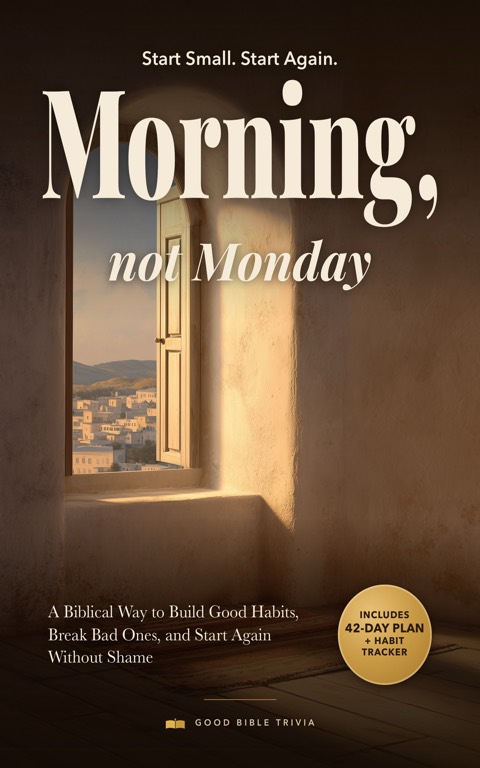
Morning, Not Monday
Build good habits, break bad ones, and start again without shame
Psalm 46 is about being still and steady when life shakes, and Morning, Not Monday is a Bible-based book on building calm daily habits and starting again.
See the book →